
Measurement definitions
This page shows how the zones and thicknesses in CorneApp results are defined.
Zones and center
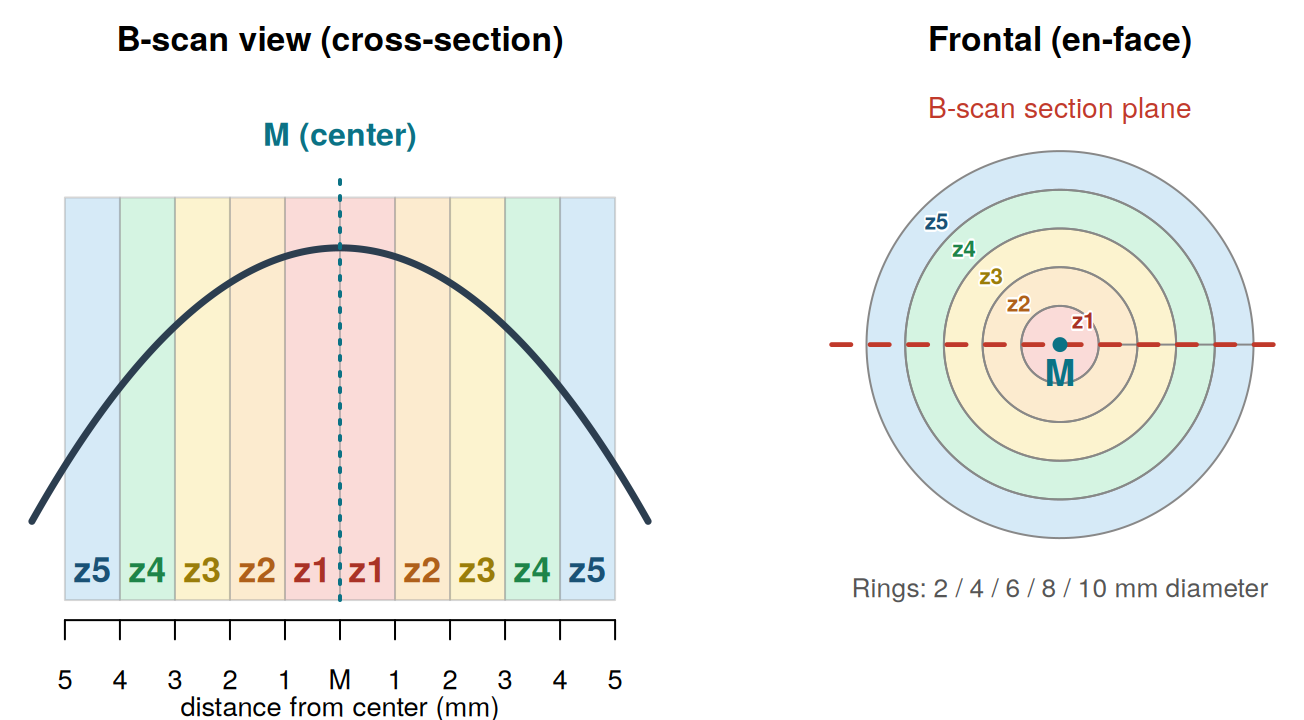
Depending on the Center line choice on the results screen, one of the two definitions below applies.
Center line: Vertex
Center definition: the anterior (outer) surface is modeled as a smooth arc by a conic fit over the full valid extent; the APEX of this arc (the steepest point) is the zone center. This is a disease-independent ANATOMICAL landmark, so the zone frame keeps the same meaning in non-keratoconus assessments (the thinnest point is a disease-oriented landmark and is shown separately). Zones are absolute-distance rings around this center: z1 |d| < 1 mm (center), z2 1–2, z3 2–3, z4 3–4, z5 4–5 mm (periphery); each ring is the union of both sides and reading from center to periphery follows the disease gradient. The thinnest point (TP) is displayed separately; the Apex box states which zone it falls in (TP–center separation is informative in keratoconus). TP-window measurements (TP ± 0.5 mm) remain anchored to TP. Honesty note: the steepest point is an ESTIMATE from a single meridian and may be affected by scan tilt; the true Kmax location requires multi-meridian topography. Thicknesses are measured perpendicular to the anterior surface; zone membership is defined by horizontal distance.
Center line: Thinnest point
Center definition: the zone center is the THINNEST POINT (TP) — the column with the minimum median-smoothed total perpendicular thickness among quality-passing columns. Being derived from the thickness profile, TP is unaffected by scan tilt and is the clinical reference point of keratoconus assessment (the Pentacam pachymetry map and the Belin-Ambrósio protocol are TP-centered); this choice serves DISEASE-ORIENTED follow-up. Zones are absolute-distance rings: z1 |d| < 1 mm (center), z2 1–2, z3 2–3, z4 3–4, z5 4–5 mm (periphery). The steepest point (conic apex) is shown separately as an ANATOMICAL landmark; its distance and zone appear in the Apex box. TP-window measurements (TP ± 0.5 mm) stay anchored to TP under either choice. Thicknesses are perpendicular to the anterior surface; zone membership is horizontal distance.
Perpendicular thickness
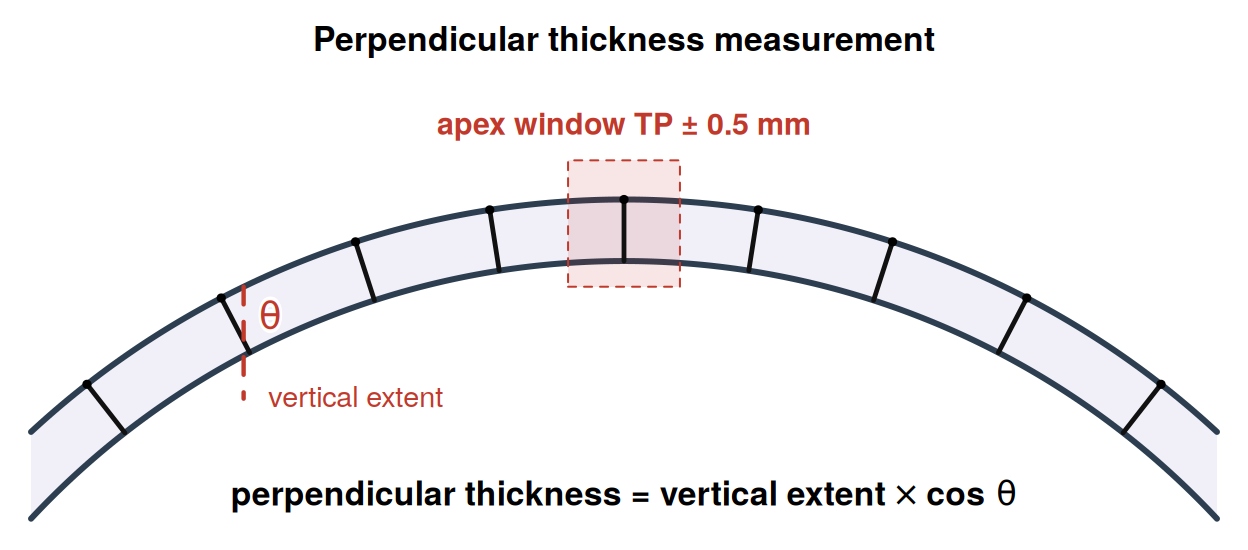
Thicknesses are measured PERPENDICULAR to the anterior surface, not as vertical pixel distance: perpendicular thickness = vertical extent × cos θ, where θ is the local surface slope. Vertical measurement systematically overestimates thickness in the sloped periphery; perpendicular measurement corrects this.